
The infusion of artificial intelligence into everyday experiences is becoming increasingly difficult to ignore. While conversations about AI often focus on its use in high-tech industries or emerging tools like autonomous vehicles and intelligent assistants, one of the most public-facing, relatable areas for this transformation is fast food. Major corporations such as McDonald’s, Wendy’s, Taco Bell, Chick-fil-A, and Starbucks are at the forefront of integrating AI-powered systems into their operations—whether it’s through automated order-taking kiosks, AI-enhanced drive-thru interactions, robotic food preparation, or dynamic demand forecasting.
Though many of these implementations aim to increase efficiency, reduce wait times, and cut operational costs, they also represent one of the most tangible ways regular people will interact with artificial intelligence in their daily lives. The average consumer may never step inside a tech company’s data center or use a neural network to solve a problem, but they will almost certainly order a meal from a kiosk that remembers their last purchase or speak with an AI that suggests meal upgrades. These moments, though seemingly mundane, are profoundly important—they set the tone for how society views, experiences, and accepts AI in both commercial and personal contexts.
This is precisely why the public should care deeply about AI’s introduction into the fast food world. These restaurants are not only mass-scale operational environments but also cultural mainstays. Their decisions influence trends, affect millions of workers, and touch virtually every demographic. As such, AI in fast food isn’t merely a corporate upgrade—it’s a public experiment with far-reaching consequences. It shapes perceptions, tests ethical boundaries, challenges labor structures, and influences policymaking, all in real time. To overlook or underreport this shift is to miss a critical chapter in the broader AI narrative—one that’s unfolding right in front of us, one burger at a time.
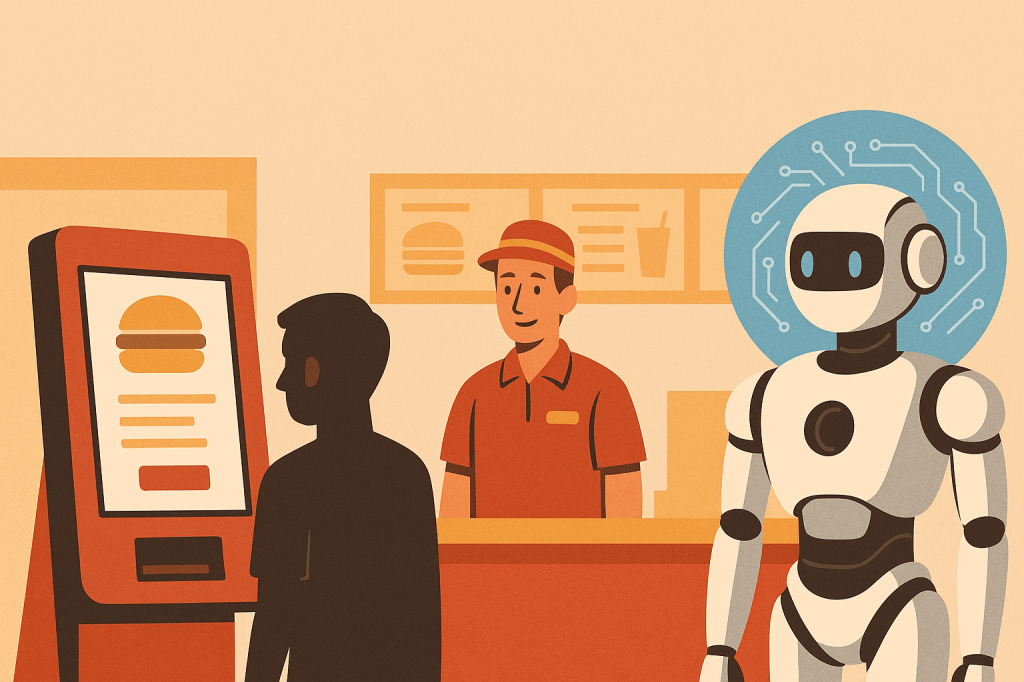
The Everyday AI Encounter
Fast Food as the Frontline of AI
As AI continues its march into society’s mainstream, fast food restaurants emerge as one of the most practical arenas for initial public contact. For many individuals, especially those who may not work in tech industries or follow developments in machine learning, fast food becomes the frontline where abstract concepts about artificial intelligence suddenly become real, visible, and consequential.
For many people, their first direct experience with AI won’t be through smart home devices or self-driving cars it will be at their local fast food restaurant. Imagine walking into a familiar burger joint and being greeted not by a person, but by a voice assistant trained to upsell you based on previous orders, or a touchscreen kiosk with facial recognition to personalize your meal preferences.
These venues are uniquely positioned as frequent touchpoints for a broad and diverse population. Whether it’s a family on a road trip, a worker grabbing lunch, or a student on a budget, the demographic served by fast food is vast. When AI technology is embedded in such familiar settings, it becomes a gateway for the average person to interact with and form opinions about AI. These are no longer futuristic hypotheticals, they are happening now, and their reach is growing.
What makes these encounters even more significant is their frequency and accessibility. Fast food restaurants serve tens of millions of customers daily across a broad spectrum of social, economic, and cultural backgrounds. This makes them fertile ground for AI normalization. When people repeatedly interact with AI systems in these settings, it can influence how they think about the technology—whether they perceive it as helpful, neutral, or intrusive. That initial impression can set the stage for broader acceptance or resistance to AI adoption in other parts of their lives, from healthcare and banking to education and transportation.
The Real-World Test Lab
AI Under Pressure: A Trial by Fire
Fast food chains aren’t just early adopters of AI technology, they’re testing labs for its refinement. With their standardized workflows, immense customer volume, and emphasis on speed and consistency, fast food restaurants provide ideal conditions to experiment with emerging tech. The AI systems deployed here aren’t confined to the theoretical, they’re under real-world pressure to perform seamlessly during a lunchtime rush or a late-night drive-thru rush.
What Happens When Things Don’t Work?
What happens when an AI can’t understand a customer’s voice through a static-filled intercom? How well do machine learning algorithms adapt to fluctuating regional preferences or limited-time promotions? How accurately do predictive systems handle inventory and staffing decisions? These environments provide answers, and the data gathered here informs how similar systems might function in sectors like retail, hospitality, and even healthcare.
Moreover, the iterative development that occurs within fast food AI systems, where software is quickly refined in response to real-world failure, accelerates the technology’s learning curve. This feedback loop makes fast food environments invaluable to AI researchers, engineers, and business leaders looking to scale AI across different domains.
Fast food restaurants serve as real-world testing grounds for AI technologies. Their high volume of customers, need for speed, and standardized operations make them ideal environments for refining AI algorithms. Observing the successes and failures in this space can provide valuable lessons for broader AI deployments in healthcare, education, and beyond.
Transparency and Accountability
Understanding the Inner Workings of AI in Fast Food
As AI’s presence expands in fast food environments, questions of transparency and accountability grow louder. These systems are often opaque to the average consumer. How are decisions made about what products to recommend? What happens to the data collected from each transaction, voice command, or facial scan? And who is responsible when an AI system fails to perform adequately—or worse, when it causes harm?
Consider language recognition systems that struggle to understand non-native English speakers, or facial recognition algorithms that exhibit racial or gender bias. These problems, well documented in the AI field, become even more concerning when deployed at scale in fast food restaurants. When customers are unfairly misinterpreted or excluded due to algorithmic limitations, it erodes trust not only in that business but in AI technology more broadly.
That’s why oversight is crucial. Consumers must know when they are interacting with AI and understand what data is being collected and why. Companies have a duty to ensure their systems are tested for bias, evaluated for performance across demographics, and built with mechanisms for redress. Transparency is not just a moral imperative, it’s a business necessity in an era where tech ethics are becoming a competitive differentiator.
Because of this widespread exposure, it is critical that media, researchers, and technologists pay attention to how these systems function, what data they collect, and how decisions are being made. For instance, if an AI-powered drive-thru system makes errors in understanding accents or dialects, it raises serious questions about inclusivity and bias. Similarly, if automation leads to job displacement, we must examine how these changes affect the workforce and local economies.
Risks to Employment in the Fast Food Sector
Automation and the Threat to Entry-Level Jobs
One of the most pressing concerns surrounding AI adoption in fast food is its potential impact on employment. As AI-powered systems become more advanced, they are increasingly capable of taking over tasks traditionally performed by human workers. This includes order taking, cooking, cleaning, and even customer interaction. While automation may lead to greater efficiency and cost savings for corporations, it simultaneously poses a threat to thousands of jobs, many of which are held by low-income workers, students, and individuals entering the workforce for the first time.
Fast food jobs have historically served as accessible entry points into the labor market. They offer flexibility, minimal educational requirements, and valuable customer service experience. However, the growing use of AI and robotics threatens to eliminate many of these opportunities. Drive-thru voice assistants can replace cashiers, robotic arms can flip burgers, and kiosks can handle orders with minimal human involvement. This shift could disproportionately affect economically vulnerable populations, exacerbating existing inequalities in the job market.
Moreover, even where jobs aren’t outright eliminated, they are likely to be redefined. Workers may be expected to manage, troubleshoot, or collaborate with AI systems, requiring new skills and training. Unfortunately, many fast food workers receive minimal training as it is, and the infrastructure for upskilling within these roles is often lacking. Without intentional investments in worker development and support, many employees could find themselves displaced or stuck in a cycle of precarious employment.
The Call for Ethical Implementation
These realities underscore the need for a broader conversation about how AI should be implemented in ways that prioritize human dignity and economic inclusion. Policymakers, business leaders, and the public must grapple with tough questions: What role should automation play in service industries? How do we balance innovation with social responsibility? What safety nets and retraining programs need to be in place to ensure no one is left behind?
Globally, between just some of the five biggest fast food restaurant companies and brands (Starbucks, McDonald’s, Chick-fil-A, Yum China Holdings, and Chipotle Mexican Grill), they are easily employing more than 3 million people. That means the broad-based adoption of AI technologies could be potentially disruptive to the employment and livelihood of a huge amount of people.
Shaping Public Perception
Fast Food as a Litmus Test for AI Acceptance
Ultimately, how AI is deployed and perceived in fast food contexts may serve as an indicator for broader societal acceptance or skepticism of artificial intelligence. These restaurants function as cultural mirrors and trendsetters, and the way they present and manage AI tools will have ripple effects far beyond their own walls.
If AI systems in fast food are seen as clunky, unhelpful, or insensitive to customers’ needs, the technology risks developing a poor public image—especially among people who may not otherwise engage with it. Poor experiences with AI at a burger counter could sour someone on the idea of AI-powered education or healthcare, even if those applications have significant potential for good. Conversely, if fast food AI is intuitive, respectful, and enhances the customer experience, it can create a foundation of familiarity and trust that makes other forms of AI adoption more palatable.
In this way, fast food becomes a proving ground not just for the technology itself, but for public sentiment. That’s why communication, transparency, and thoughtful design are so essential—not just for the benefit of business, but for the larger ecosystem of AI acceptance and ethical implementation.
Looking Ahead
A Turning Point for Tech and Society
AI in fast food isn’t just about quicker service or modern convenience, it represents a convergence of technology, ethics, labor, and public experience. These venues are some of the first and most frequent contact points for the general public to experience artificial intelligence firsthand. As such, they offer a crucial window into both the promise and the peril of widespread AI deployment.
From real-time feedback on algorithm performance to the social and economic impacts on frontline workers, fast food settings encapsulate a microcosm of the broader AI debate. That’s why it’s imperative that we scrutinize how AI is rolled out in these spaces, with eyes wide open to both its efficiencies and its inequities. Reporting on these developments isn’t just good journalism, it’s a public service.
Whether it’s informing policy, guiding ethical tech development, or simply helping consumers make informed choices, our collective awareness and vigilance will shape the story of AI in ways that truly matter. And in this case, that story may well begin with a drive-thru speaker or a glowing self-order kiosk.
[mailerlite_form form_id=3]
 Sapiens Forward