
McDonald’s has announced a major expansion of its artificial intelligence (AI) capabilities across its 43,000 global locations. The company is leveraging AI-powered predictive analytics and computer vision technology to enhance equipment maintenance, order accuracy, and overall restaurant efficiency. These innovations aim to improve both customer experience and employee working conditions by reducing machine downtime and operational stress.
One of the key AI implementations involves predicting equipment failures, particularly for high-demand machines like ice cream dispensers. Additionally, McDonald’s is exploring AI-driven order verification systems using camera-based computer vision technology to reduce errors in food preparation. This move is part of the company’s broader strategy to increase its customer base from 175 million to 250 million by 2027.
While these technological advancements promise greater efficiency and convenience, they also raise concerns about job security, data privacy, and potential biases in AI-driven decision-making.
Additionally, this move comes after McDonald’s announced the conclusion of its AI-powered drive-thru testing in partnership with IBM, which began in 2021. The pilot program, which aimed to automate voice ordering, encountered mixed results. Challenges included inconsistent order accuracy, issues with recognizing different regional accents and dialects, and technological limitations that led to frustrating customer experiences. For instance, social media users often reported bizarre or incorrect orders, fueling skepticism about the viability of such AI solutions.
Despite these setbacks, McDonald’s has made it clear that it is not stepping away from AI entirely. Instead, the company is using the lessons learned from the IBM pilot to refine its approach and plans to make an informed decision about voice ordering technology later this year. The end of the IBM partnership does not signal a retreat from automation but rather a pivot towards more reliable and integrated AI systems.
This article takes a closer look at how McDonald’s is integrating AI, the benefits and risks associated with these innovations, and what this could mean for the future of the fast-food industry.
AI’s Growing Role in Fast Food
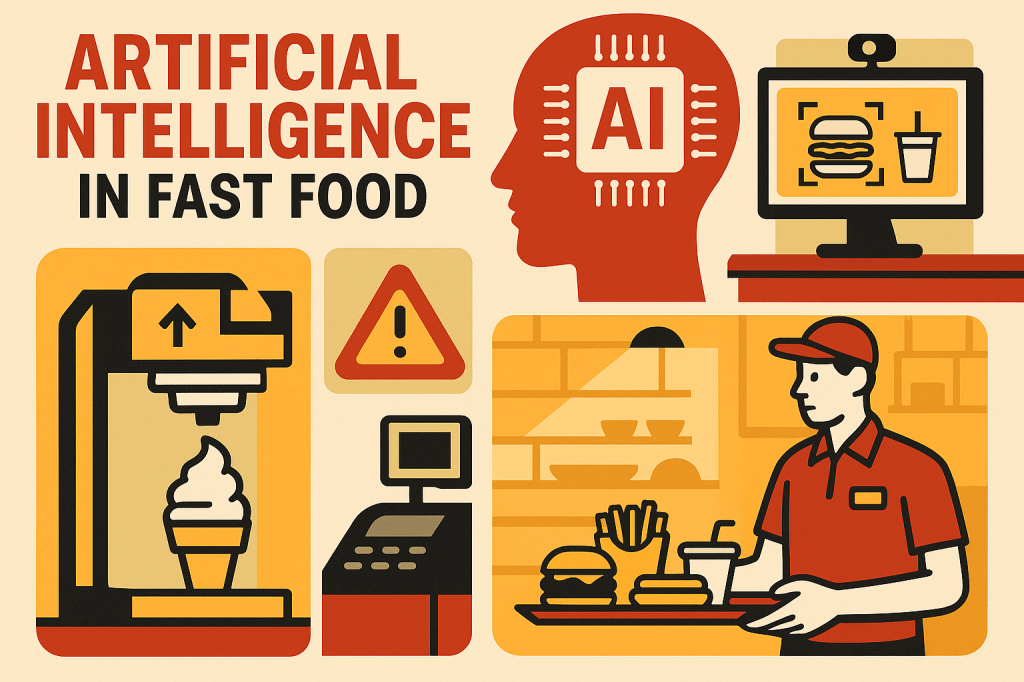
Artificial intelligence is increasingly being integrated into fast food operations, with major brands investing in automation and smart analytics to improve efficiency. McDonald’s has been a leader in AI adoption, previously experimenting with AI-powered drive-thrus and automated voice ordering systems. Now, the company is expanding its AI usage to include:
- Predictive maintenance for equipment, reducing machine breakdowns and service disruptions.
- AI-powered computer vision to verify order accuracy and streamline food preparation.
- Cloud-based monitoring for franchisees to track restaurant performance in real time.
This initiative aligns with a broader industry trend of automating restaurant operations to enhance customer satisfaction while reducing operational inefficiencies. However, it also sparks debate about technology replacing human workers and how these changes could impact employees, franchise owners, and customers. Moreover, the industry must consider how to ensure fairness and transparency in AI deployment, including addressing algorithmic bias and protecting consumer data.
How McDonald’s AI Initiative Will Work
Predictive Analytics for Equipment Maintenance
One of the most significant challenges for McDonald’s has been unreliable equipment, particularly its ice cream machines, which have become infamous for frequent breakdowns. To address this issue, McDonald’s is implementing AI-driven predictive maintenance systems that:
- Use edge computing to transmit real-time machine performance data to the cloud.
- Allow franchise owners to monitor equipment health remotely and schedule repairs before failures occur.
- Reduce customer frustration and lost revenue due to unavailable menu items.
This predictive approach is expected to minimize downtime and improve operational efficiency, but it also raises questions about reliance on proprietary technology and how franchisees will manage potential costs associated with AI system upgrades. It also places increased importance on technical training for staff and the development of robust support infrastructure.
AI-Powered Computer Vision for Order Accuracy
McDonald’s is also exploring computer vision technology to verify order accuracy and reduce errors in food preparation. This system would:
- Utilize AI-powered cameras to track ingredients and monitor assembly.
- Identify errors before orders are served, ensuring customers receive exactly what they requested.
- Help reduce food waste by catching mistakes early in the preparation process.
For customers, this could mean fewer incorrect orders and a smoother dining experience. However, concerns about privacy and data collection arise when implementing AI-powered surveillance in kitchen environments. Critics argue that increased surveillance could also contribute to workplace stress or be used punitively rather than constructively.
For me personally, the need to check my bag of food after every time I go to McDonald’s has become pretty tiresome. It almost seems like the universe has determined that every time I forget to check the bag some item of food will be missing. I have to say that I welcome any technical solution which will improve the accuracy of my food order.
The Impact on McDonald’s Workforce
As AI and automation take on more responsibilities, questions about job security in the fast-food industry become increasingly relevant. Key concerns include:
- Will AI reduce the need for human employees?
- How will McDonald’s balance automation with workforce retention?
- Will employees need to be retrained to manage and maintain AI-driven systems?
While McDonald’s states that AI is meant to enhance employee efficiency rather than replace jobs, automation has historically led to workforce reductions in many industries. Ensuring job security and fair labor practices will be an important challenge moving forward. Retraining programs, employee support initiatives, and clear communication will be essential to avoid alienating the workforce.
The Broader Industry Implications
McDonald’s AI expansion is part of a larger trend in the fast-food industry, with companies like Wendy’s, Burger King, and Taco Bell also investing in automation.
In the U.S. –
- Wendy’s partnered with Google Cloud to develop “Wendy’s FreshAI” chatbot.
- White Castle teamed up with SoundHound AI for voice-powered AI technology.
- Panera, Arby’s and Popeyes are testing OpenCity’s “Tori” voice assistant.
- Chipotle is using AI to enhance it’s recruitment processes.
In the U.K. –
- Popeyes U.K. has also launched an AI-powered drive-thru.
As AI becomes more embedded in restaurant operations, businesses must carefully consider how to balance efficiency with ethical concerns. A shift toward AI-powered kitchens will likely reduce dependency on manual labor but that will assuredly impact employment opportunities for a large segment of populations.
Going in a different angle though, as these fast food corporations explore greater reliance on cloud-based monitoring and delivery systems, they will consequently be increasing the importance of data security and infrastructure reliability. Labor issues at a single restaurant would naturally be confined to a single location, however significant system outages with a centralized AI order management solution could theoretically shutdown operations world-wide simultaneously. A single point of failure in a high-tech infrastructure poses an enormous risk for any global enterprise.
The Future of AI in Fast Food
McDonald’s AI expansion represents yet another significant shift in how fast-food chains approach technology and automation. By leveraging predictive maintenance, computer vision, and AI-powered monitoring, McDonald’s aims to enhance operational efficiency, reduce downtime, and improve customer satisfaction.
However, these changes also introduce new challenges:
- Concerns about job displacement and automation’s impact on workers.
- The ethical implications of AI-powered surveillance in kitchens.
- Potential technical and security risks associated with cloud-based restaurant management.
As McDonald’s moves forward with its AI strategy, the success of these innovations will depend on how well they balance technological advancements with ethical considerations. Will AI-driven restaurants become the norm, or will concerns about automation and privacy slow down this trend?
Only time will tell how these developments shape the future of fast food, employment, and customer service.
[mailerlite_form form_id=3]
 Sapiens Forward